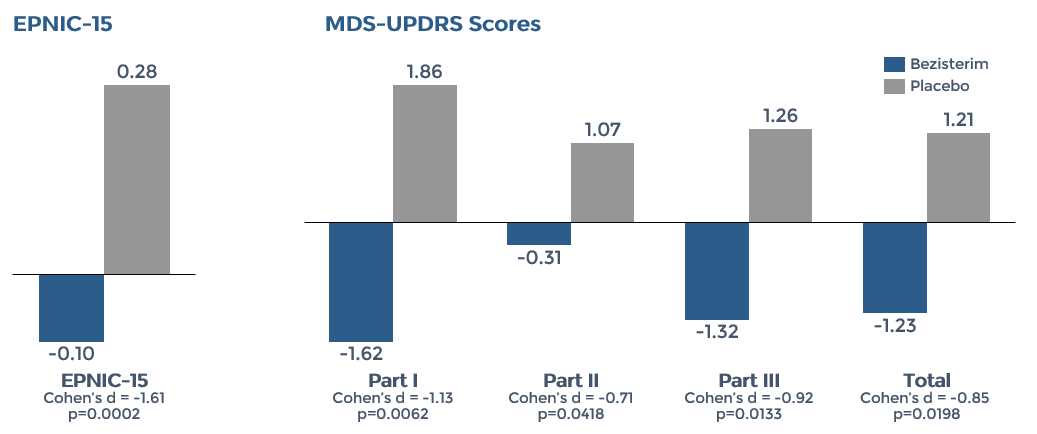
The SUNRISE-PD trial was a Phase 2, multicenter, randomized, double-blind, placebo-controlled trial designed to establish proof-of-mechanism and proof-of-concept in patients with early-stage PD that had not previously been treated with carbidopa/levodopa. Under the statistical analysis plan submitted to the U.S. Food and Drug Administration (FDA), the study’s primary pharmacodynamic assessment focused on changes in a predefined panel of blood-based inflammatory markers of disease. The study also evaluated motor and non-motor endpoints, clinician-rated outcomes, quality-of-life, and safety and tolerability measures to assess bezisterim’s activity and clinical profile in early PD, with the goal of informing the design of a potentially pivotal Phase 3 trial.
The trial successfully met prespecified endpoints and achieved its objectives, with topline results showing that bezisterim improved blood based inflammatory markers of disease, along with a broad range of biological markers associated with overall cellular health and nerve cell damage. Participants treated with bezisterim experienced greater improvements than those receiving placebo across a series of clinical outcome measures of daily living, motor symptoms, and non-motor symptoms
While bezisterim appeared to demonstrate an effect across the trial population, the greatest improvement was seen in those with higher levels of inflammation at baseline. Baseline platelet concentration, a biomarker associated with inflammatory status, identified subgroups in which treatment effects were more pronounced, providing further support for a potential role of inflammation in Parkinson’s disease. Among patients with baseline platelet counts >230 x103/µL, who represent approximately one-half of the trial population, bezisterim treatment was associated with statistically significant advantages over placebo across all clinical measures evaluated, including EPNIC-15 and MDS-UPDRS Parts I, II, and III, and MDS-UPDRS Total.